November 22, 2026, 3:21 am

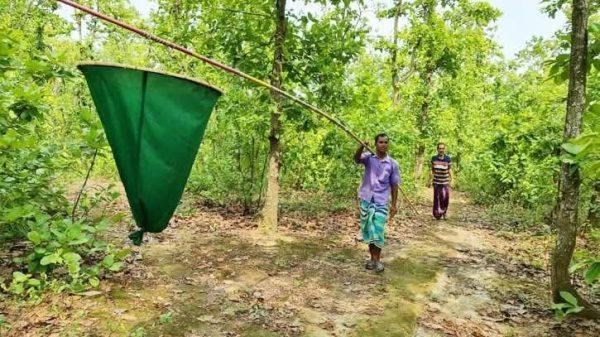

Muhammad Abu Helal, Sherpur Correspondent:Their lives are defined by a constant struggle amidst the hills, forests, and nature. Driven by the need to earn a living, they head deep into the woods at the break of dawn—some scaling towering trees, others traversing the hilly terrain from one end to the other. Their sole objective: to collect red ant eggs. In the villages of the Garo Hills—located along the border in Sherpur’s Jhenaigati Upazila—approximately 300 people sustain their livelihoods by collecting and selling these eggs. This seasonal activity, which spans three to four months of the year, serves as a vital source of income for many families.A species of large red ant builds its nests in various trees across the Garo Hills, including Sal, Gajari, Mahogany, mango, and litchi trees. To protect their eggs, the ants construct specialized nests by binding four to five leaves together at the tips of tree branches using their own saliva. The eggs are kept safely inside these leaf-nests.During specific times of the year, the collection of these eggs brings a flurry of activity to these border-hilly communities. From morning until midday, collectors roam the forest to gather the eggs, followed by a marketplace in the afternoon where they are bought and sold.Men and women from villages near the hills—such as Samaschura, Ramchandrakura, Bakakura, and Gazni—are involved in this trade.Collectors explain that they harvest the eggs from tree branches using a cloth net attached to the end of a long bamboo pole. A single large nest can yield between 100 and 150 grams of eggs. On average, a collector can gather anywhere from 500 grams to one kilogram of eggs per day. In local markets, these eggs fetch between 1,200 and 1,400 Taka per kilogram. Once collected, the eggs are packed into cartons and sent to wholesalers.The primary buyers of these ant eggs are recreational anglers, as they are highly sought after as bait for fishing with a rod and line. During the fishing season, prices rise in tandem with demand. Additionally, ant eggs are used as feed for pet birds. Local wholesalers purchase these eggs from collectors, package them, and distribute them to major cities across the country, including Dhaka and Mymensingh.Ananta Saha, who has long been involved in collecting these eggs, says, “In the past, they were abundant in the hills. Now, with the decline in vegetation, the number of ant nests has also decreased. Still, in the hope of earning a living, I go out searching for them every day at dawn.”Describing the hardships of the work, collector Maha Koch remarks, “Ant bites are extremely painful. But for the sake of my income and my family, I have to endure it. I’ve grown accustomed to the pain by now.”Local buyer Elias Uddin (42) explains, “We source the eggs from the local market, package them, and send them to the capital and various other districts. The supply of red ant eggs peaks during the monsoon and winter seasons, which is also when sales are strongest.”However, this seasonal livelihood is far from risk-free. Beyond the constant threat of ant bites, collectors face the danger of encountering wild elephants, snakes, and swarms of bees in the forest. Climbing tall trees also presents a significant hazard. Nevertheless, driven by the need to survive, these collectors continue their work, braving all such adversities.This unique, nature-dependent profession sustains the lives and livelihoods of approximately 300 people—comprising both indigenous Garo hill-dwellers and the local Bengali population. For several months each year, their households rely on the income generated from collecting and selling these ant eggs. Given the limited employment opportunities in the remote, rugged terrain of the hills, red ant eggs have become more than just a natural resource; they are a vital means of survival.